In an earlier post I used “the void” as a metaphor but since then the idea has been floating around in my head. I like the idea of exploring the cosmos and coming upon the void but I had no idea what the void really was. for the metaphor it just has to be a mass to be shouted into and the name alone conjures an image of an all consuming darkness. I didn’t like the idea of it being a black hole so I started looking for other astronomical phenomenon. I was listening to the fantastic podcast Midnight Burger and I heard about Barnard 68 and immediately dove down the rabbit hole.
Barnard 68
Edward Barnard
Barnard 68 is one of the dark Nebulae cataloged by Edward Barnard and Mary Ross Calvert in 1919. Barnard was and old school self made scientist, in less than favorable conditions in the post civil-war south, he started as a photographers assistant and supplemented his income by discovering comets. The young scientist spent his working hours tending a solar camera and using his wages he bet on himself buying his first telescope, which cost him around nine months of wages, and using it to discover comets which earned him $200 each through the Warner prize. He used this extra income well first marrying, then buying himself a house where he could “sit and watch Jupiter to his hearts content”.
Barnard’s contributions to astronomy were huge, helping to disprove the Martian canals theory, pioneering of new photographic methods that allowed him and his colleagues to study the structure of the Milky Way. Barnard’s love for the cosmos led him on a journey of understanding the phenomena which danced on the other side of his lens and throughout his career he studied comets, moons, planets, Novae, and Nebulae greatly adding to our understanding of the universe. With the help of his assistant and niece, Mary Ross Calvert, who helped to finish the work after his death, Barnard cataloged around 370 dark nebulae.

Dark Nebulae & Block Globules
Dark Nebula are interstellar clouds. These clouds are filled with Sub micrometer-sized dust particles coated in frozen Carbon Monoxide and Nitrogen, as well as many other transparent particle, which effectively block physical light from passing through them. They are the parts of the sky that seem devoid of stars (de-Void nice).
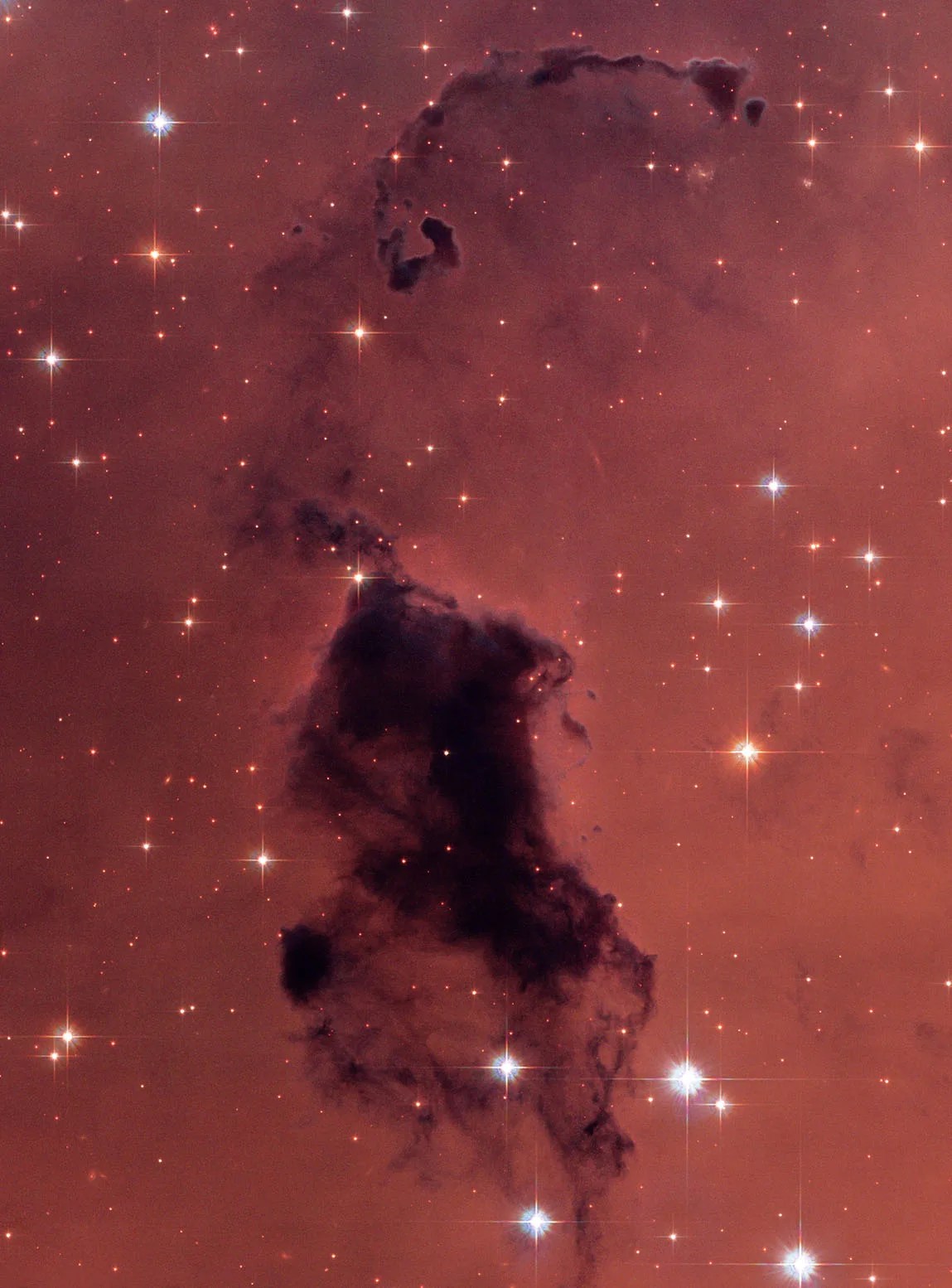
“These opaque, dark knots of gas and dust called “Bok globules” are absorbing light in the center of the nearby emission nebula and star-forming region, NGC 281. Bok globules may form stars, or may eventually dissipate.”(Credit NASA, ESA, and The Hubble Heritage Team (STScI/AURA); Acknowledgment: P. McCullough (STScI))
Barnard 68 is an especially dense nebula known a Bok Globule, named for Bartholomeus Bok who was one half of an astronomical power couple with Priscilla Fairfield whos love for each other was equaled only by their love for the stars, co-authoring papers and books while working side by side at the Royal Astronomical Society. The Boks were fascinated with gas and dust clouds, such as those cataloged by Barnard, as well as the lifecycles of stars. Bart in an incredible statement later in his career said “I have been a happy astronomer for the past sixty years, wandering through the highways and byways of our beautiful Milky Way.”
A hearty Australian habit enjoyed by staff in every Stromlo department, and from all parts of the world. (Australia, Holland, UK, NZ, USA, Sweden, Hungary, Germany, Poland, Russia etc.).
(© Copyright Helen Bailey Bayly.Mail0009.jpg Gallery Administrator 681 x 874 px)
Bok studied these specific Dark Nebulae which bear his name. They are isolated and relatively small but incredibly dense. These masses of space dust are observed to be about a light year across, meaning that even if we achieve light speed traveling through one of these globs would mean traveling in total darkness for a full year. Entering one would be like seeing the stars extinguished, the emptiness of space replaced with an oppressive mass of stuff that eat light itself. The density of these clouds also stops heat from entering their masses resulting in them being some of the coldest parts of the known universe.
Bok hypothesized, and was later proven right, that these globules were the cocoons in which space dust came together and underwent gravitational collapse transforming the particles from a caterpillar of dust into the beautiful butterfly that is a multiple-star system. The mass of dust creates its own gravity pulling the material inward and the gravitational pull increase the pressure and compresses the dust together, the pressure increase results in a temperature increase and as these factors increase over time eventually the temperature and the pressure build to the point of thermonuclear fusion. Once fusion occurs the mass starts to release energy in the form of light and heat. If the conditions are right and the gravity pulling in and the energy pushing out find an equilibrium a stunning, stable star(or two or even three) takes its place in the cosmos. These dense clouds of darkness are made up of all the stuff that makes stars, Light born from darkness, heat from out of the cold, cosmic poetry at its finest.
And just like that the void from my imagination has shape, substance, and a collection of scientific work on its machinations.
Joseph Parker 7/9/24
 Rumbly Race Co
Leave a comment